MAIN POWER OFF ON
loading systems...
or press Enter ↵
Computer Engineering @ Boston University

Ozan
Ekame

Hardware-to-software engineer — FPGA logic gates up to C++ compiled WASM running natively in the browser. Five languages, three continents, one engineering degree in progress.

TEKTRONIX TDS2024 — CH1
LIVE
TIME: 2ms/div
VOLT: 500mV/div
TRIG: AUTO
COUP: DC
scroll
About Me

Hardware to Software, All the Way Down

I'm Ozan Ekame Pekgoz, a Computer Engineering student at Boston University who builds at every level of the stack — from Verilog FSMs on FPGA to WASM-compiled C++ running natively in the browser.

I care about understanding why things work, not just that they do. When I built the Color Sorter, the interesting part wasn't gluing an Arduino to a sensor — it was designing the light-robust thresholds and the deterministic servo control loop that made it 95% accurate across 100 trials.

Outside engineering: BU College of Engineering Student Advisor, basketball coach, AI Society and Mars Rover Club member. Also piano, surfing, and vinyl.

Languages Spoken
🇪🇸 Spanishnative 🇹🇷 Turkishnative 🇬🇧 Englishnative 🏳 Catalanfluent 🇫🇷 Frenchintermediate
FPGA
Verilog / Vivado
BU
Comp. Engineering
5
Languages spoken
May
'27
Graduation
Skills

Technical Proficiencies

Hardware & FPGA
Verilog FPGA Vivado Arduino Embedded C Cadence VLSI Oscilloscope Soldering I²C / SPI PCB Wiring
Programming
C / C++ Python WebAssembly JavaScript HTML / CSS Java MATLAB Bash Git
CS & Theory
Digital Logic Computer Architecture Algorithms Data Structures Discrete Math FSM Design OS Concepts Circuit Analysis
Projects

What I've Built

Experience

Work & Involvement

BU College of Engineering Student Advisor Volunteer
Summer 2025 – Present
Boston University
Boston, MA
  • Advising incoming students on academic paths, course planning, and engineering program resources.
Sales & Product Management Intern
May 2024 – Aug 2024
Dima Textile
Barcelona, Spain
  • Expanded customer base by presenting product lines directly to prospective clients at company HQ.
  • Tracked garment production in Excel to ensure accurate, on-time delivery.
IT Support Technician Intern
Jul 2022
Alliance Healthcare
Istanbul, Turkey
  • Troubleshot hardware and software issues; assisted with server security maintenance and order-tracking systems.
Education

Academic Background

Boston University, College of Engineering

B.S. Computer Engineering
Physics-first approach applied to circuits, digital logic, and embedded systems. Student Advisor for the College of Engineering. Member of AI Society, Mars Rover Club, and Barbell Club.
Computer ArchitectureVLSI Design CircuitsLogic & Design ElectronicsSoftware Engineering AlgorithmsDiscrete Math Probability & Statistics
Expected
May 2027
Contact

Let's Connect

Open to internship opportunities in hardware, embedded systems, or software engineering. Reach out directly — I respond fast.

ozanekame@gmail.com
Color Sorter Machine CLASS WINNER
EK210 · Arduino + TCS34725 · Jan–May 2025
View Repo
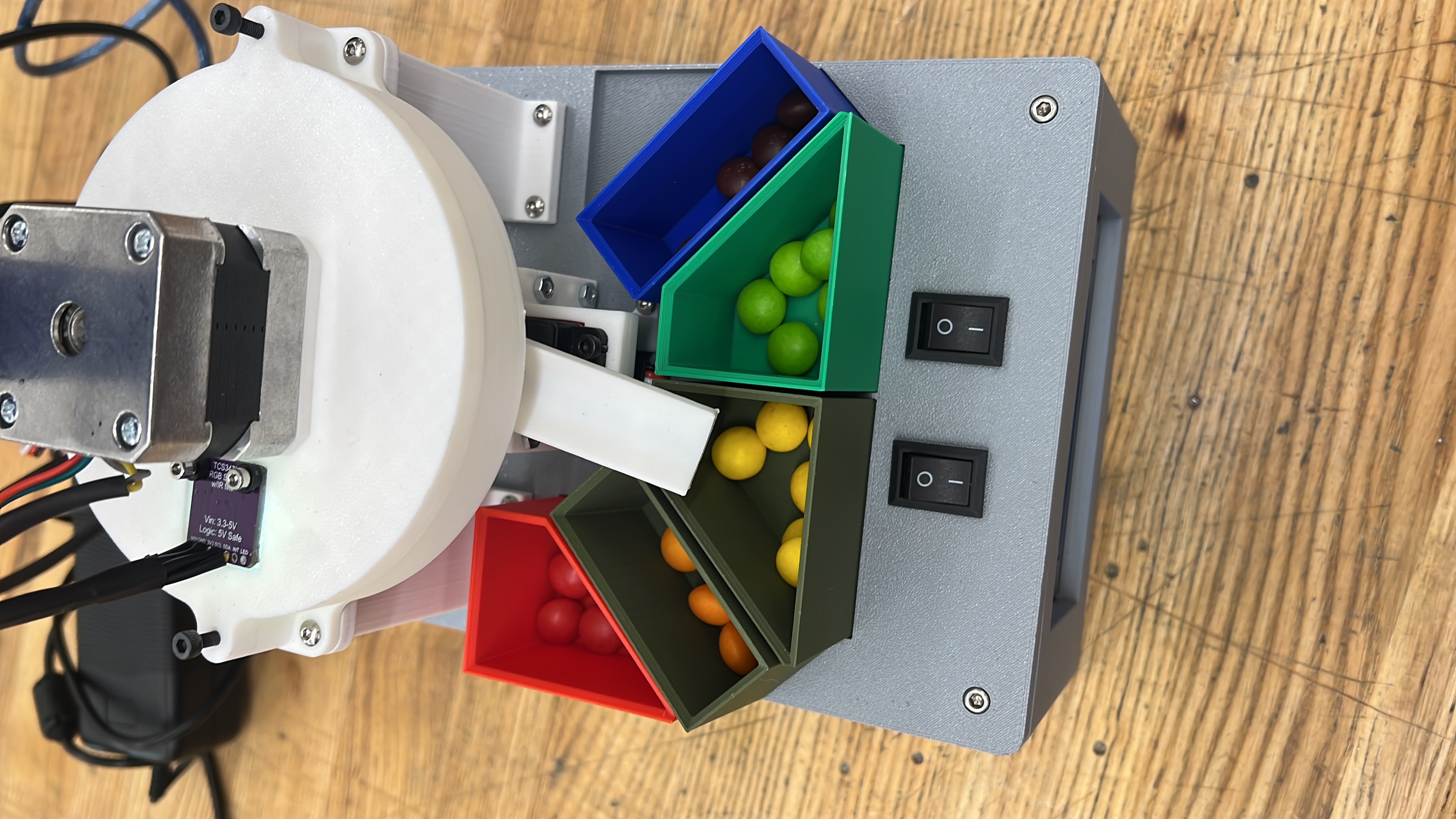
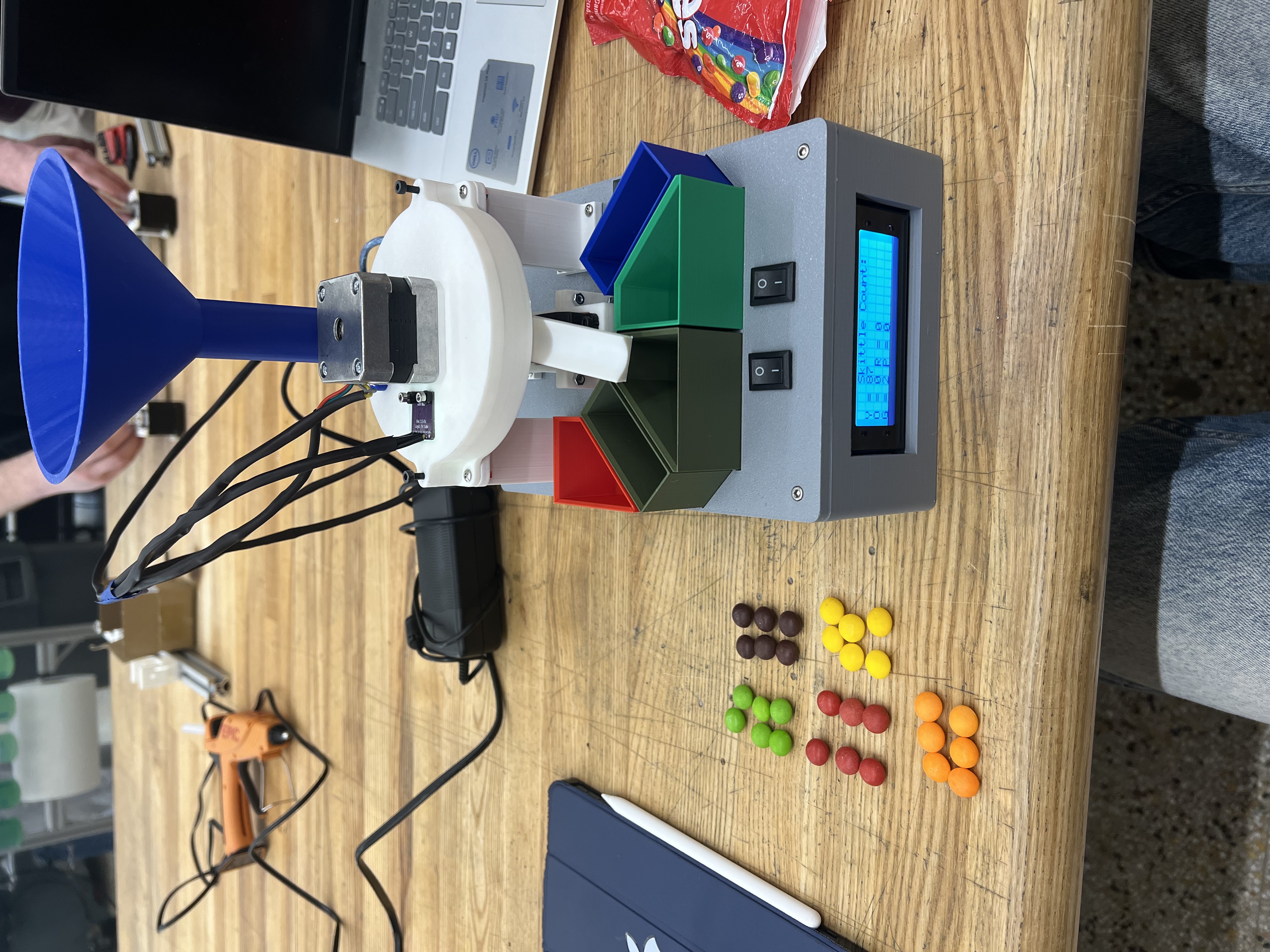
TCS34725 RGB Sensor I²C · SDA/SCL Arduino Uno Classify Color threshold logic SG90 Servo Chute Position D9 PWM NEMA17 Stepper Rotate Bin Disk TB6600 Driver 20×4 LCD Live Counts 95% accuracy · 100 trials · ~10 items/min · under $106
Our EK210 design challenge was to build a fully automated machine that could physically sort objects by color with minimal human intervention. Manual sorting is slow and error-prone — we needed a reliable, reproducible system using affordable parts and code I could tune myself.
I built the full sensing and control pipeline: an Adafruit TCS34725 RGB sensor reads R/G/B/C values over I²C, an Arduino classifies the color using tunable threshold windows, a servo motor positions the drop chute to the correct bin, and a NEMA17 stepper advances the bin disk. A 20×4 I²C LCD displays live per-color counts. I wrote two sketches — a minimal sensor readout for calibration, and the full control loop for production.
Arduino C++I²CServo PWMStepper ControlTCS34725TB6600 DriverLCD Display
Calibrating optical sensors in variable ambient light taught me that hardware accuracy is a loop, not a one-time setting. I learned how to write modular firmware (one sketch per concern), manage shared grounds across mixed-voltage rails (3.3 V sensor, 5 V logic, 12 V stepper), and translate a physical concept into a deterministic control loop. The machine won the class award for highest accuracy and lowest cost.
My role: Code & sensor/LCD wiring — wrote all Arduino firmware and tuned detection thresholds across 100 test trials.
FPGA Binary Conversion Game
Verilog · Xilinx Nexys A7 · 100 MHz · Jan–May 2025
View Repo
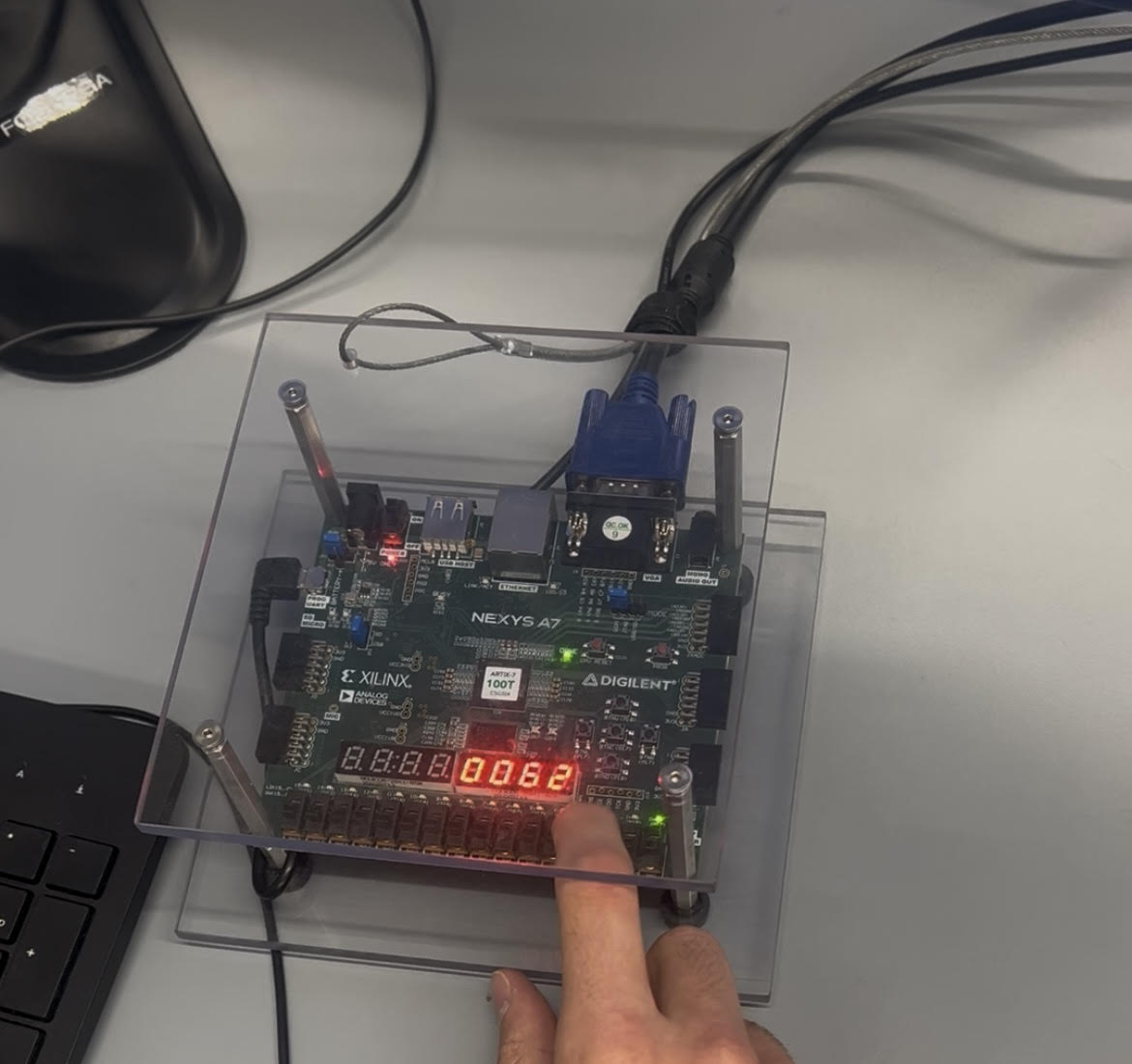
Random Counter LFSR / up-to 4095 Game FSM state control debounced BTN Binary→BCD 12-bit conversion integer division Display MUX time-division scan ≈1 kHz refresh 7-Seg LED 8 digits Nexys A7 SW[11:0] input LED_CORRECT output 100 MHz CLK · 4 testbenches · MIT license
Design and implement a complete digital logic system on a real FPGA using only Verilog — no processors, no firmware, no shortcuts. The goal was to build something interactive that exercises every layer of hardware design: timing, state control, I/O, and display multiplexing, all running at 100 MHz.
I built a binary conversion game on the Xilinx Nexys A7. A pseudo-random counter generates a decimal number shown on the 7-segment display. The player uses 12 switches to enter its binary equivalent and presses OK to submit. Correct answers light an LED and expand the difficulty range. The full stack is pure Verilog: a top-level FSM, a Binary-to-BCD converter using integer division, a multiplexed 7-segment driver refreshing at ~1 kHz, hardware debounce logic, and a clock divider. Each module has its own testbench simulated in Vivado.
Verilog HDLFSM DesignVivadoXilinx Nexys A7Binary→BCD7-Seg MuxClock DividerTestbenches
This project made clock domains, propagation delays, and synthesis constraints concrete — not just textbook concepts. Writing testbenches forced me to think adversarially about edge cases before touching hardware. I learned how to decompose a complex system into independently verifiable modules, and why a well-structured FSM makes the rest of the design simple. It was my first end-to-end experience taking HDL from simulation to a running bitstream on real silicon.
Unit Converter Web App
EC327 · C/C++ → WASM · JavaScript · Sep–Dec 2024
View Repo
User Interface HTML + JS 15+ categories WASM Engine C / C++ → .wasm native precision Custom Units user-defined rules + / - / * / x History Log session record export .txt runs fully offline · no server required · all compute in-browser via WASM
Build a unit converter web app for EC327 (Software Engineering) that works fully offline, supports 15+ conversion categories, handles custom unit rules, and runs all calculations with native precision — not just JavaScript's floating-point approximations.
The back end is written in C/C++ and compiled to WebAssembly, so every calculation runs natively inside the browser at near-native speed. The JavaScript front end handles UI events, routes inputs to the WASM module, and manages a history log that users can download as a .txt file. Custom unit rules let users define conversion formulas using +/−/×/÷ with a variable x. We worked around a CORS issue (that blocked a local-server approach) by embedding everything into a single HTML file.
WebAssemblyC / C++JavaScriptHTMLOffline-FirstCustom Unit EngineHistory Export
This was my first real exposure to the WASM compilation pipeline — taking C++ unit field logic, compiling it with Emscripten, and bridging it into a live web page. I learned how browser security policies (CORS) shape architecture decisions, how to work effectively in a 7-person team across front-end and back-end boundaries, and how to write reusable C++ conversion modules that are testable independently of the UI.
My role: Back-end unit fields (C/C++), WASM compilation pipeline, integration testing. ~50% of back-end work.